


 United States (USD)
 Singapore (SGD)
 African Country (USD)
 Australia (AUD)
 Canada (USD)
 Egypt (USD)
 European Country (EUR)
 Hong Kong (HKD)
 India (USD)
 Indonesia (IDR)
 Iran (USD)
 Iraq (USD)
 Japan (JPY)
 Myanmar (USD)
 Oman (USD)
 Qatar (USD)
 Saudi Arabia (USD)
 Switzerland (CHF)
 Taiwan (USD)
 Turkey (USD)
 UAE (USD)
 United Kingdom (GBP)
 International (USD)
 Written by
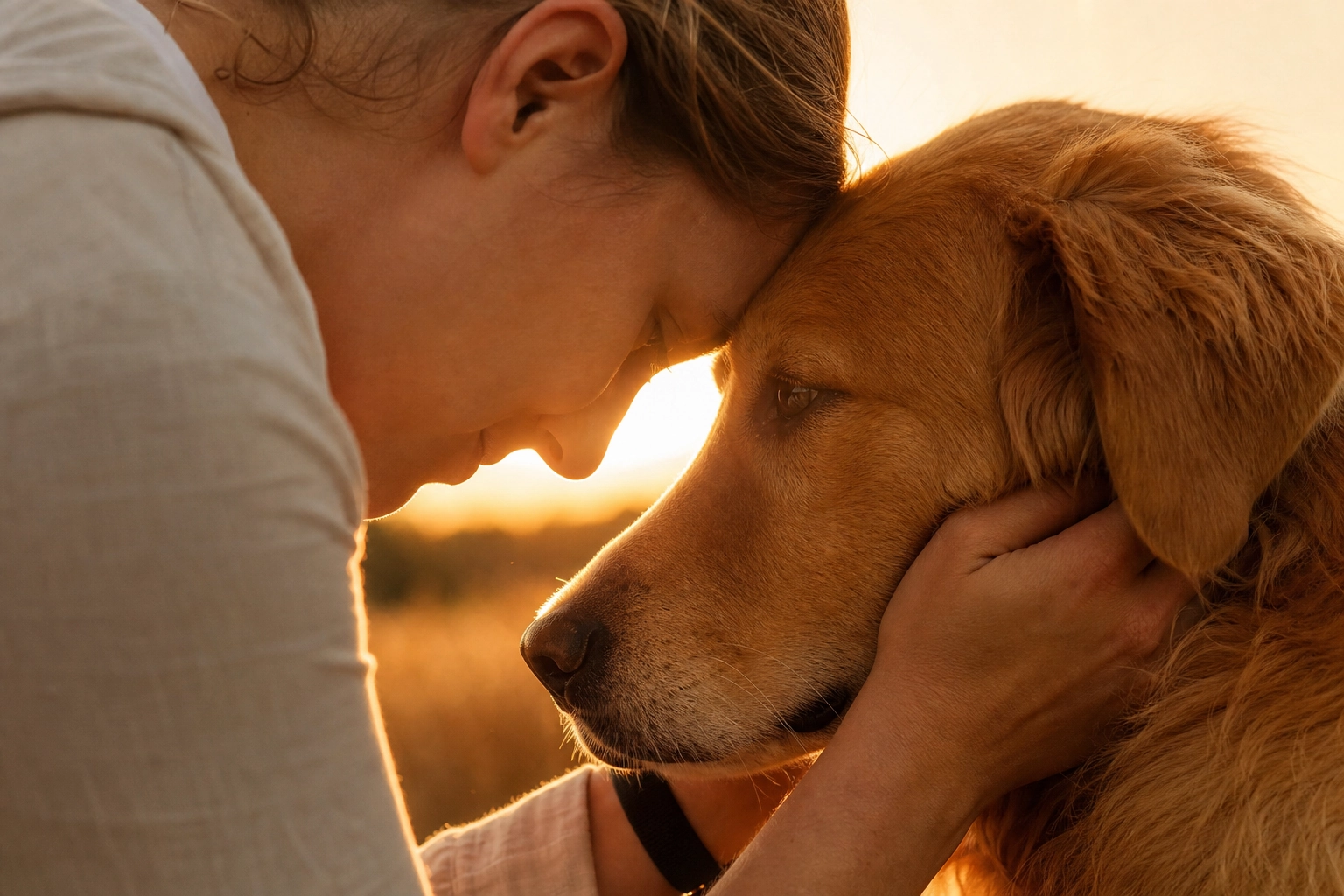
Why is the bond between us and our dogs so deep it's hard to put into words? Part of the answer hides in biology. When we gaze at each other, both human and dog release oxytocin, the love hormone of mother and child.
As someone who has always worked with genetics and health, I'm forever fascinated by one question: why is the bond between us and our dogs so deep it's hard to put into words? Part of the answer hides in the biology of us both.
When we gaze into the eyes of a dog we love, both our bodies release a hormone called oxytocin — the same hormone that builds the bond between mother and child. A landmark study in Science found that gazing between a dog and its owner raised oxytocin levels in both — a phenomenon not seen in wolves (Nagasawa et al., Science, 2015), a remarkable love loop passing back and forth.
What I find most magical is that it's a two-way loop. When we gaze at our dog, our oxytocin rises, so we pet and play with them more, which raises their oxytocin too, so they come closer and gaze at us more — a cycle that strengthens the bond ever tighter. Moreover, when researchers gave dogs oxytocin nasally, the dogs gazed at their owners longer, which in turn raised the owners' oxytocin (Romero et al., PNAS, 2014). This connects with genes and dog behavior.
This relationship didn't happen by chance. Dogs have stood beside humans for tens of thousands of years, co-evolving until they developed a special ability to read human emotions and facial expressions better than any other animal. Even the "puppy-dog eyes" look is a product of evolution — research shows dogs evolved a muscle above the eye (the levator anguli oculi medialis) that wolves lack, letting them raise the inner eyebrow so their eyes look larger and more infant-like, triggering a nurturing response in humans (Kaminski et al., PNAS, 2019). The bond is therefore embedded in the nature of both species.
As the founder of a brand that cares for the health of both people and pets, I believe understanding the science of this bond helps us see our pets as true family members, not just animals. And caring for their health as best we can is how we repay the love they give us every day. And when we want them to stay with us as long as possible, we naturally care about our own longevity too — I wrote about this on the human-health side in the FOXO3 longevity gene on Geneus DNA. This connects with genetics and pet lifespan.
Next time your dog runs to you with sparkling eyes, know that it's not just cuteness but a genuinely deep biological bond. Caring for them so they're healthy and stay with us for a long time is the most precious thing. If you'd like to know your pet more deeply at the DNA level, feel free to consult the Geneus Pet team.
1. What is oxytocin?
Oxytocin is the bonding hormone, released when human and dog gaze at each other, helping build connection between them — the same hormone that builds the mother-child bond.
2. Does gazing at my dog really help bonding?
Yes. A study in Science found that gazing between human and dog raises oxytocin on both sides, a two-way love loop — something not seen in wolves.
3. Why do dogs understand human emotions so well?
Because dogs co-evolved with humans for tens of thousands of years, developing a strong ability to read human emotions and faces, and even facial muscles specialized for communicating with humans.


