


 United States (USD)
 Singapore (SGD)
 African Country (USD)
 Australia (AUD)
 Canada (USD)
 Egypt (USD)
 European Country (EUR)
 Hong Kong (HKD)
 India (USD)
 Indonesia (IDR)
 Iran (USD)
 Iraq (USD)
 Japan (JPY)
 Myanmar (USD)
 Oman (USD)
 Qatar (USD)
 Saudi Arabia (USD)
 Switzerland (CHF)
 Taiwan (USD)
 Turkey (USD)
 UAE (USD)
 United Kingdom (GBP)
 International (USD)
 Written by
Why are some breeds so clearly more prone to certain cancers? Explore breed predisposition, germline vs somatic mutations, a breed-to-cancer-risk table, and how to plan proactive screening.
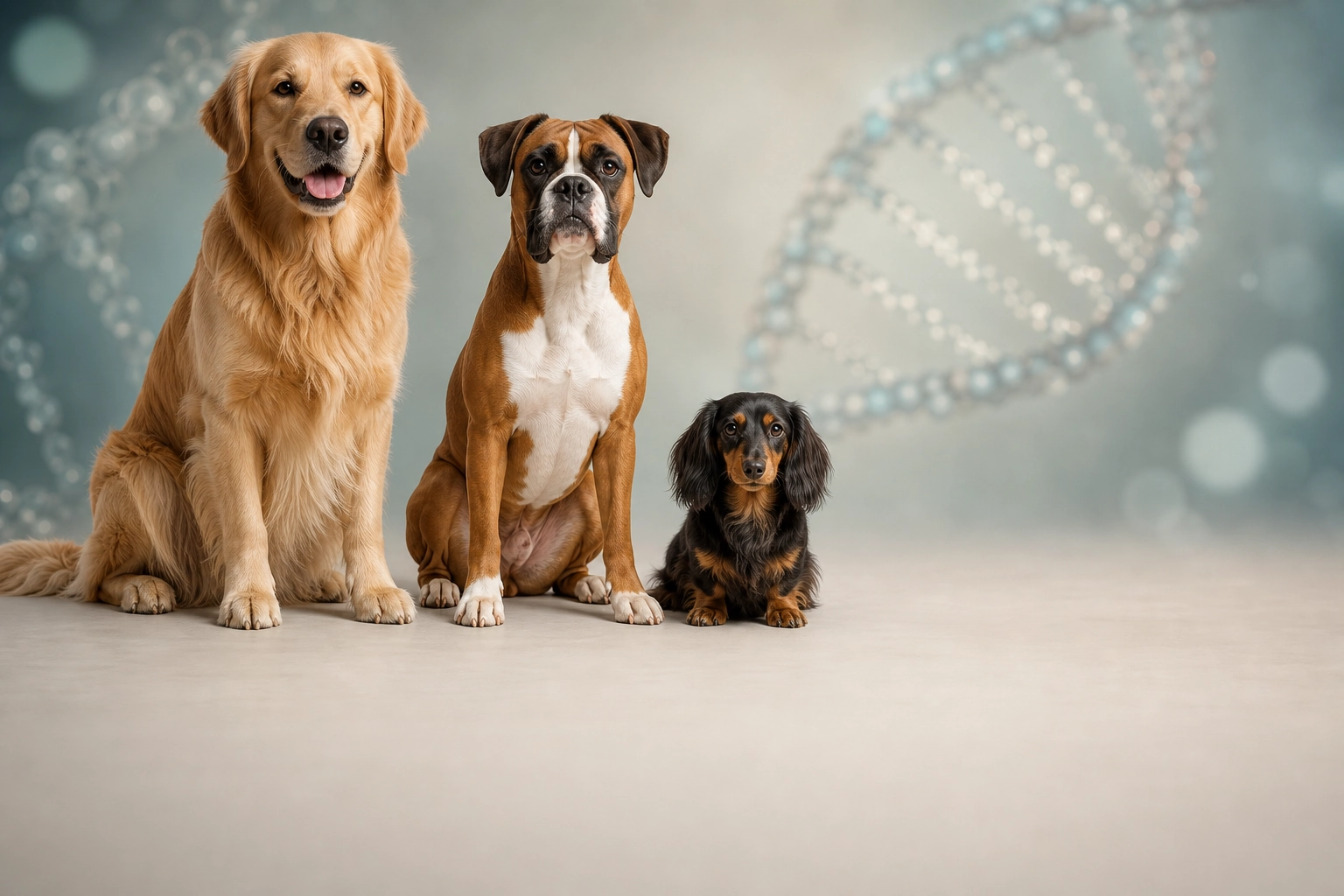
When we choose a dog, we usually consider looks, size, and temperament that fit our lifestyle. But from a modern veterinary standpoint, something else is passed down inseparably with those breed traits: a "genetic risk code" for cancer (breed predisposition). Today I will explore with you why some breeds are so clearly more prone to certain cancers than others.
Classic work by Dr. Jane M. Dobson shows that historical selective breeding for desired physical traits created a "genetic bottleneck" — causing certain cancer-driving genes to accumulate especially heavily within those purebred populations (Dobson, ISRN Veterinary Science, 2013).
And a recent report from Italian animal cancer registries (2025) analyzing over 26,000 histopathology cases found some striking figures (Fonti et al., Research in Veterinary Science, 2025):
A recent 2025 review in Veterinary Oncology explains that cancer in dogs is driven by genomic aberrations, split into two main layers (Arendt et al., Veterinary Oncology, 2025).
These are present from birth, common in specific breeds, giving them a higher-than-normal "baseline risk", for example:
These arise in body cells during life, often triggered as the dog ages or by environmental factors (chemicals, cigarette smoke, or chronic inflammation), damaging the cell-division control system and eventually forming a tumor. Read more in Decoding canine cancer genetics: Somatic vs Germline.
This table maps common breed-to-cancer links to help owners watch the right signs.
| Breed | High genetic-predisposition cancer | What owners should watch for |
|---|---|---|
| Golden Retriever / Labrador | Lymphoma, Hemangiosarcoma | Lumps at neck/groin, sudden pale gums, enlarging abdomen |
| Boxer / Pug / Bulldog | Mast Cell Tumor | Fast-growing red skin bumps that wax and wane, like an insect bite |
| Rottweiler / Great Dane | Osteosarcoma (bone cancer) | Limping, swollen leg, severe leg pain with no wound |
| Bernese Mountain Dog | Histiocytic Sarcoma | Lethargy, appetite loss, faster-than-normal weight loss |
| Brittany Spaniel / Min. Pinscher | Mammary Tumors | Small lumps along the mammary line (common in unspayed dogs) |
| Scottish Terrier / West Highland White Terrier / Shetland Sheepdogs / Beagles / Border Collies | Urothelial Carcinoma | Straining to urinate, painful urination, increased frequency of urination or incontinence, decreased urine stream and blood in the urine |
We can't edit the genetic code a dog inherits — but knowing breed predisposition is a "treasure map" for proactive planning.
Knowing what your dog is at risk for isn't meant to alarm you — it's "information as power" that lets you stay one step ahead. Because in the world of cancer, early detection is the best opportunity to treat and to give them the most quality time (healthspan) with us. Read how to cope with a suspected diagnosis in our owner's guide to cancer in dogs, and on extending quality years in Healthspan: 6 ways to extend your dog's life.
Medical disclaimer: Breed information is a risk-tendency assessment, not a diagnosis. If you find a lump or any abnormality, see a veterinarian for a thorough examination.
Interested in genetic testing to assess your dog's risk and identify their breed for proactive care planning? Reach out to me and the Geneus Pet team anytime. 🧬🐕
1. Why are some purebred lines more prone to certain cancers?
Partly true. Research shows some purebred lines have a higher genetic risk for certain cancers — Golden Retrievers for lymphoma/hemangiosarcoma, Rottweilers for bone cancer — due to historical selective breeding that concentrated certain cancer-driving genes within those breed populations.
2. Are lumps found on dogs mostly benign or malignant?
In a study of 26,000+ tumors in Italy, 58.4% were malignant and 41.6% were benign, with malignancy risk rising 8% per year of age. That's why early detection matters so much.
3. Does spaying really reduce mammary cancer risk?
Spaying a female before her first or second heat greatly reduces mammary cancer risk, especially in high-risk breeds like the Brittany Spaniel. However, discuss the right timing with your vet — particularly for large breeds.


