


 United States (USD)
 Singapore (SGD)
 African Country (USD)
 Australia (AUD)
 Canada (USD)
 Egypt (USD)
 European Country (EUR)
 Hong Kong (HKD)
 India (USD)
 Indonesia (IDR)
 Iran (USD)
 Iraq (USD)
 Japan (JPY)
 Myanmar (USD)
 Oman (USD)
 Qatar (USD)
 Saudi Arabia (USD)
 Switzerland (CHF)
 Taiwan (USD)
 Turkey (USD)
 UAE (USD)
 United Kingdom (GBP)
 International (USD)
 Written by
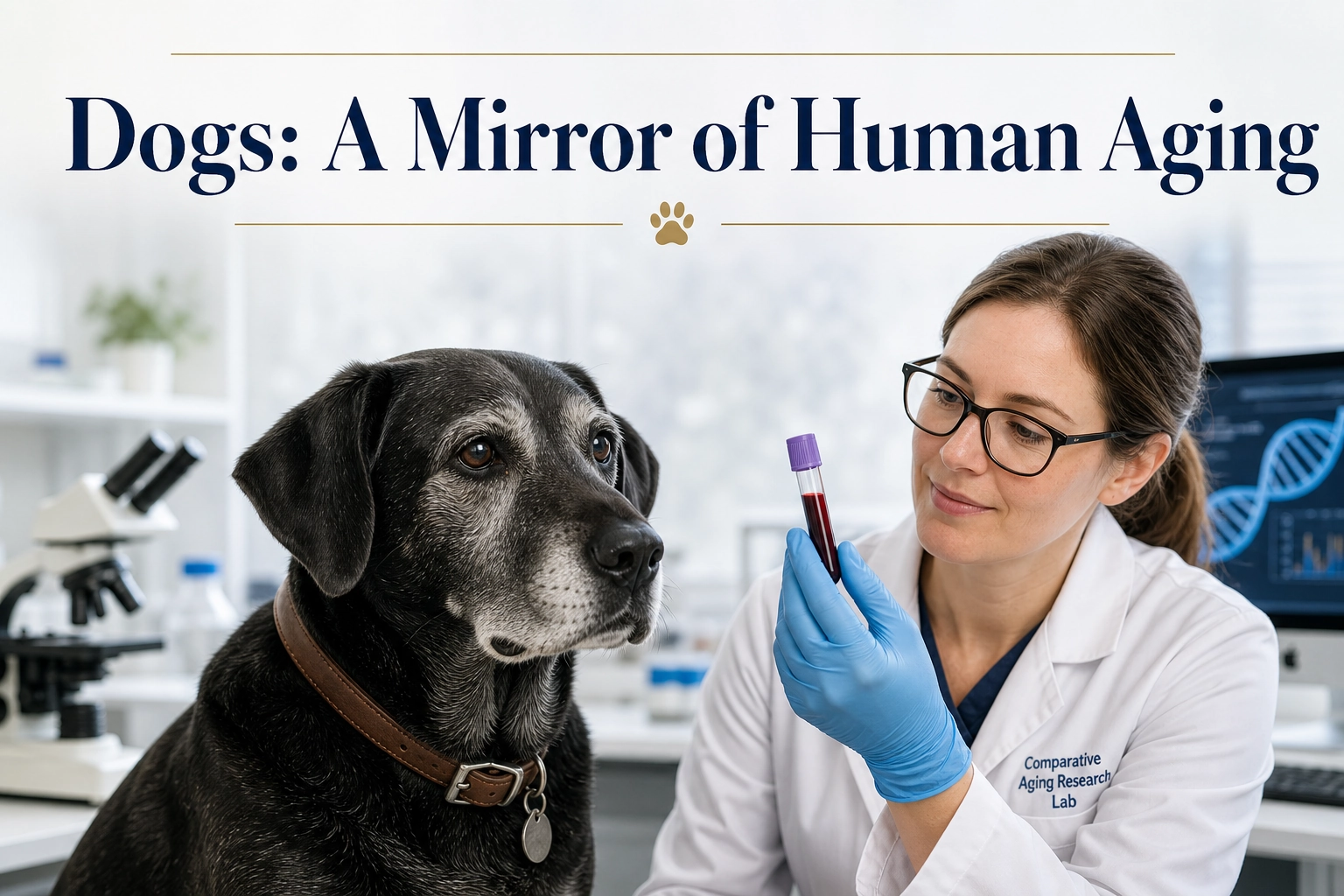
Dogs don't just help us live longer — they're helping scientists unlock how humans age. A new study found dogs and humans share a blood "signature of mortality," discovered many times faster than in human studies.
In our earlier article we talked about how owning a dog may help you live longer. But today I want to show you the even more remarkable flip side — dogs aren't just making us healthier; they're helping scientists unlock how humans age.
It's a long-term study following over 50,000 companion dogs across the US to understand the genetic and environmental factors that shape a dog's "aging trajectory" — everything from what they eat, where they live, and their social environment to their exercise schedule (Dog Aging Project).
The answer lies in how strikingly similar they are to us. Companion dogs:
This is the discovery that shook the field. Researchers analyzed blood from 937 dogs in the project's Precision Cohort, measuring 133 plasma metabolites to see which predicted death. They found 23 metabolites significantly associated with mortality — and when compared against nine human studies, those same metabolites predicted mortality in humans in the same direction (correlation r = 0.52) (Harrison et al., The Journals of Gerontology: Series A, 2026).
The most striking part: researchers followed the dogs for an average of just 2.6 years to find these biomarkers, whereas the human studies required 8–22 years of follow-up to reach the same answer.
Digging deeper, most of these metabolites relate to kidney function in both species, suggesting that age-related decline in kidney function may be a shared physiological axis of aging.
It means the dog lying at your feet right now may be a key that helps humans understand aging many times faster. And in return, every advance from this research loops back to help our dogs live longer, better lives too. This is a genuinely mutual relationship.
But while we wait for the lab breakthroughs, there are things we can do today to extend our dogs' quality years. Read more in Healthspan: 6 science-backed ways to extend your dog's life.
As a veterinarian, this moves me every time I think about it — dogs have stood beside humans for tens of thousands of years, and now they're helping us again by becoming a mirror that shows us how our own bodies age. What we can do in return is care for them as well as today's science allows.
1. Why do researchers use dogs to study human aging?
Because companion dogs are genetically diverse, live in our environment, and get the same age-related diseases we do — but live much shorter lives, so a whole lifespan can be observed in a few years.
2. What did the latest study find?
A study of 937 dogs found that blood metabolites predicting mortality in dogs matched those found in humans significantly, and most relate to kidney function.
3. Why is studying dogs faster?
Because dogs live shorter lives, researchers found these biomarkers after an average of just 2.6 years of follow-up, while human studies needed 8–22 years.


