


 United States (USD)
 Singapore (SGD)
 African Country (USD)
 Australia (AUD)
 Canada (USD)
 Egypt (USD)
 European Country (EUR)
 Hong Kong (HKD)
 India (USD)
 Indonesia (IDR)
 Iran (USD)
 Iraq (USD)
 Japan (JPY)
 Myanmar (USD)
 Oman (USD)
 Qatar (USD)
 Saudi Arabia (USD)
 Switzerland (CHF)
 Taiwan (USD)
 Turkey (USD)
 UAE (USD)
 United Kingdom (GBP)
 International (USD)
 Written by
Does your dog bark at dark corners at night because it sees a ghost? Let's unpack the mystery with science — through the 4 superpowers of a dog's senses that far outmatch our own.
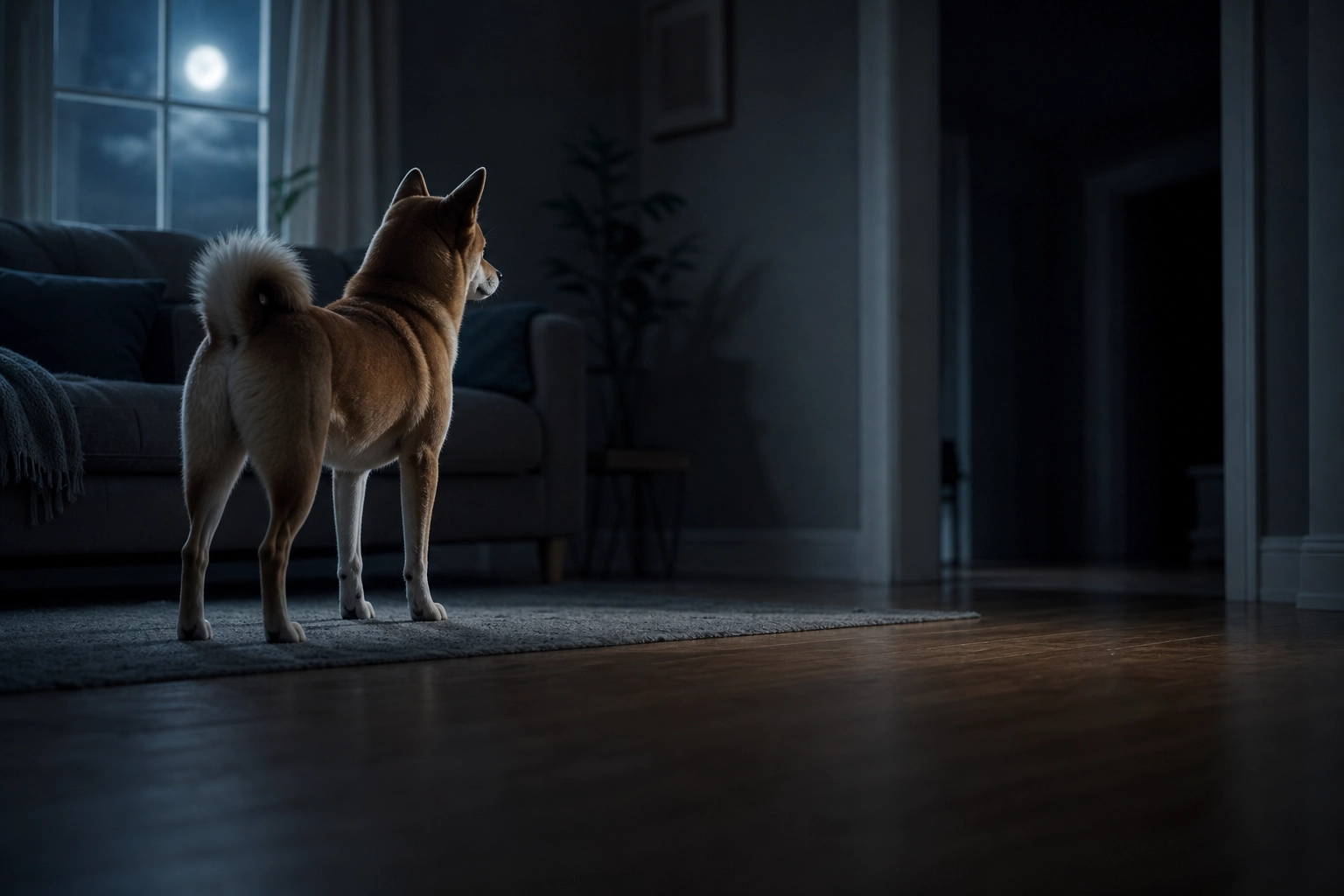
Has this ever happened to you? Late at night, you're relaxing at home when your dog suddenly stands up, fixes an unblinking stare on a dark corner, lets out a low growl, or barks at what looks like "nothing at all" — leaving the hair on your arms standing up! I understand that feeling completely, and I'm sure many pet parents have quietly wondered whether their dog is seeing "something" we can't. Today, let me walk you through this little mystery with a scientist's lens.
If you ask scientists point-blank, "Can dogs see ghosts?", the official answer is "there is currently no scientific evidence to support it." But interestingly, the animal-behaviour field doesn't slam the door shut on the idea either.
Russell Hartstein, a certified dog behaviour consultant and trainer based in Los Angeles, offered a thought-provoking point: the most fascinating thing about behavioural science is that "there is still an enormous amount we don't know." So the possibility that dogs can sense something humans cannot perceive isn't impossible at all.
"The most fascinating part of behavioural science and understanding dogs is that there is still so much we don't know." — Russell Hartstein
Dr. Mary Burch, Director of the AKC Family Dog program and an animal behaviourist, points out that many canine behaviours get interpreted through "the owner's own beliefs." For example, if an owner already leans toward the supernatural, and they see their dog repeatedly staring at the same spot on a wall — then later learn something unfortunate once happened there — they'll often be instantly convinced the dog saw a spirit.
In reality, your dog's behaviour is rooted in both its senses and its individual temperament and emotions, which are shaped in part by genetics. If you'd like to understand what shapes your dog's personality, read more in Genes, Temperament and Your Dog's Personality.
Dr. Burch notes that while "sixth sight" lies beyond what science can prove, what we can prove is that a dog's basic senses are many times sharper than ours. These are the physical cues that make dogs look like they have a "sixth sense."
Dogs have eye structures excellent at detecting faint changes in light and shadow, especially at night or dusk. They also detect motion faster than we do and have a wider field of view (they can see to the side without turning their head).
When your dog barks at a dark corner, they're probably not seeing Casper the ghost — they may be spotting a tiny insect moving, dust drifting through a beam of light, a gecko's shadow, or even a pile of laundry on a chair that our eyes just can't catch, but theirs see clearly!
A dog's ears can pick up sound frequencies as high as 64,000 Hz, whereas humans top out at around 20,000 Hz — and they hear from far greater distances than we do.
If your dog suddenly tilts its head to listen or barks at empty space, it may be hearing a dying smoke-detector battery, a humming ceiling-fan motor, an automatic air freshener spraying, or pipes shifting under the floor. These strange high-frequency sounds can easily startle and unsettle a dog — especially one that's already sound-sensitive. For tips on caring for a noise-fearful dog, read Storm Phobia and Noise Fear in Dogs.
A dog's nose has up to 300 million scent receptors (humans have only about 6 million). They can sense changes in barometric pressure and natural phenomena with distinctive odours. On top of that, dogs can "smell your emotions" through chemical signals (chemosignals) that our bodies release — such as the scent of stress or fear.
So if you're walking your dog late at night and it suddenly seems frightened, hackles raised, growling — check yourself first. Are you feeling uneasy? Your dog may not be scared of a roadside ghost at all; it may be smelling the fear coming off of you and panicking right along with you!
Dogs are sensitive to low-frequency vibrations below 20 Hz (infrasound), waves the human ear cannot hear. Dogs pick them up through sensory organs like their whiskers and paws.
These waves often come from large air-conditioning units, distant aircraft, shifts in the Earth's crust before an earthquake, or old water pipes creaking in the walls. This is one reason so many people believe animals "know in advance" before a natural disaster.
Viewed through science, a dog's sixth sense is really instinct plus an immediate trust in whatever its body senses. When we humans feel something odd, our brain starts to analyse and dismisses it — "it's nothing, I'm imagining things." But a dog stays honest to that feeling instantly. The moment they sense something is off (even just a faint vibration or sound), they react — waiting at the door before you get home, or barking a warning. It's not supernatural; it's simply the remarkable nature of our four-legged friends.
1. Scientifically, can dogs actually see ghosts or supernatural things?
There is currently no scientific evidence to support it. Staring at or barking at empty space usually happens because a dog is responding to physical stimuli in its surroundings that are too subtle for human senses to detect. It's not about a 'sixth sight' or anything supernatural.
2. Which of a dog's senses are so sharp that people think they have a 'sixth sense'?
It comes down to 4 powerful senses: night vision that catches light, shadow and motion better than ours; hearing that reaches up to 64,000 Hz; a nose with 300 million scent receptors that can even 'smell fear'; and sensitivity to low-frequency vibration below 20 Hz felt through whiskers and paws.
3. When my dog suddenly growls or barks at a dark corner, how should I react?
Stay calm and steady. If you get nervous, your dog will smell your stress and grow more anxious. Use a relaxed tone to redirect its attention, invite it to play with a favourite toy, or use a treat to cue a 'sit' and bring the focus back — rather than scolding, which only adds stress.
4. Why do dogs seem to 'know in advance' before an earthquake or storm?
Because dogs are sensitive to low-frequency infrasound below 20 Hz and can detect changes in barometric pressure through their whiskers, paws and nose. These waves and scents appear before humans notice any threat, which makes it look as though the dog senses events ahead of time.


