


 United States (USD)
 Singapore (SGD)
 African Country (USD)
 Australia (AUD)
 Canada (USD)
 Egypt (USD)
 European Country (EUR)
 Hong Kong (HKD)
 India (USD)
 Indonesia (IDR)
 Iran (USD)
 Iraq (USD)
 Japan (JPY)
 Myanmar (USD)
 Oman (USD)
 Qatar (USD)
 Saudi Arabia (USD)
 Switzerland (CHF)
 Taiwan (USD)
 Turkey (USD)
 UAE (USD)
 United Kingdom (GBP)
 International (USD)
 Written by
The home we think is safest can hide a silent threat to our dog's health. Dogs are a sentinel species reflecting toxin risk before humans. Learn the 3 household chemical groups linked to cancer, and a checklist for a safer home.
Hi, it's Dr. Mon. Today I want to invite you to look at what seems like the "safest" place of all — our own "home." Because the home we think of as the safest space can hide a silent threat to our dog's long-term health without us realizing it, especially when it comes to "cancer."
Miners once used a "canary" to warn of toxic gas, because the bird would show signs before humans did. Modern research suggests that dogs also act as a "sentinel species" in the same way — because they live in the same environment and take in the same toxins as us, but with their shorter lifespan they show the effects of exposure as disease sooner (Canine on the Couch, 2024).
Importantly, dogs also have unique risk factors that expose them to more household toxins than us:
Literature reviews find that the cancers most studied for environmental factors in dogs are bladder cancer, mammary cancer, and lymphoma (Canine on the Couch, 2024).
This group has the clearest evidence links. Lawn herbicides (like 2,4-D and glyphosate) are associated with increased risk of urothelial carcinoma of the bladder, because dogs walk on treated grass and then lick their paws. Some flea-and-tick products and organophosphate compounds are also associated with a higher lymphoma risk (AKC Canine Health Foundation).
Indoor cigarette smoke is a carcinogen that affects dogs differently by face shape. Long-nosed (dolichocephalic) breeds have a large nasal cavity that traps toxins, so they're at higher risk of nasal cancer. Meanwhile, in flat-faced (brachycephalic) breeds, toxins pass deeper into the lungs, linking them to lung cancer.
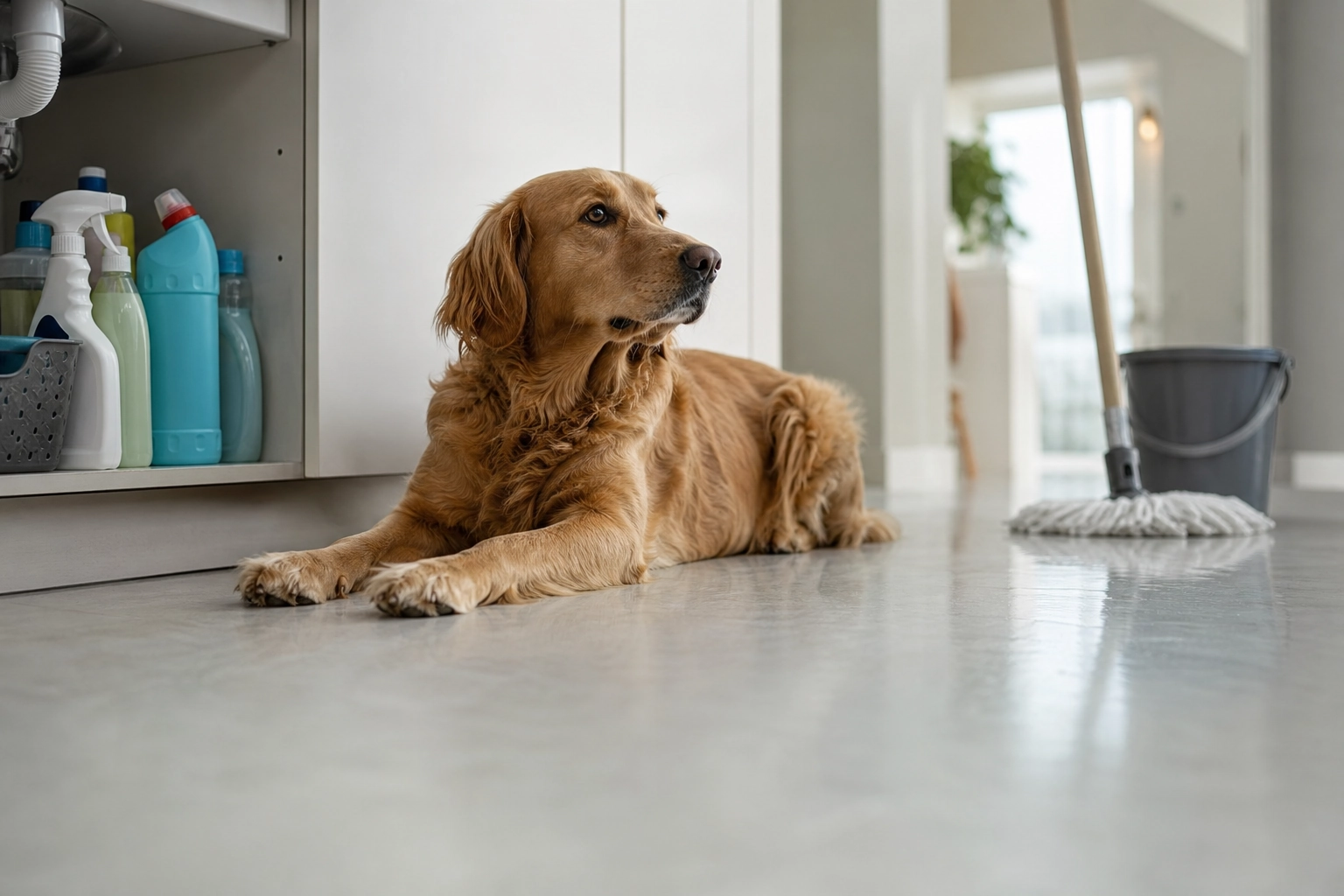
Floor cleaners, air fresheners, and carpet/sofa coatings can release volatile organic compounds (VOCs) such as acrolein, and PFAS compounds, that cause oxidative stress and chronic inflammation — triggers that put cells at risk of mutation. A study that measured household substances directly (a 37-pair case-control) found levels of arsenic (in water/dust) and acrolein (in air) worth watching in homes of dogs with bladder cancer (Braman & Trepanier, Vet Comp Oncol, 2024).
For scientific accuracy, I have to be candid: most research in this area finds an "association" using questionnaires or geospatial data (like county-level pollution) — it is not yet direct proof of "causation." A recent critical appraisal notes that we still need more case-control studies that directly measure carcinogens in the home and in the dog's blood/urine to firm up the links (Environmental exposure and cancer in dogs: a critical appraisal, 2024). That means there's no need to panic — but "reducing risk proactively" is the smart choice.
We can't control every risk factor in the world, but "home" is the space we can manage with our own hands. Caring about your dog's surroundings reduces the "toxic burden" that could trigger cellular mutations over the long term. Combined with understanding your dog's genetic background, it lets you provide proactive care across every dimension. Read more on genetics in decoding canine cancer genetics, and on coping with a suspected diagnosis in our owner's guide to cancer in dogs.
Medical disclaimer: This is preventive information; many of the links are associational, not a diagnosis or a definitive causal conclusion. If you notice any abnormality, consult a veterinarian.
Want to care for your dog proactively and understand their individual risks? Reach out to me and the Geneus Pet team anytime. 🏠🐕
1. Do lawn sprays or pesticides really raise a dog's cancer risk?
There's a link. Research shows lawn herbicides (like 2,4-D and glyphosate) are associated with increased bladder cancer risk, because dogs walk on treated grass and lick their paws. Keep dogs off the area for 24–48 hours after spraying, and wipe their paws after every walk.
2. Is secondhand smoke really dangerous for dogs?
Yes, it's harmful. Secondhand smoke is a carcinogen for dogs too. Long-nosed breeds are at higher risk of nasal cancer, while in flat-faced breeds toxins pass deeper into the lungs, linking them to lung cancer. The best option is no smoking indoors or in the car.
3. So do household chemicals definitely cause cancer?
Not quite. Most research finds only an association, not direct proof of causation. Researchers still need studies that measure substances in the home and in the dog directly. That said, reducing risk proactively is a smart choice.


