


 Thailand (THB)
 United States (USD)
 Singapore (SGD)
 African Country (USD)
 Australia (AUD)
 Egypt (USD)
 European Country (EUR)
 Hong Kong (HKD)
 India (USD)
 Indonesia (IDR)
 Iran (USD)
 Iraq (USD)
 Japan (JPY)
 Myanmar (USD)
 Oman (USD)
 Qatar (USD)
 Saudi Arabia (USD)
 Switzerland (CHF)
 Taiwan (USD)
 Turkey (USD)
 UAE (USD)
 United Kingdom (GBP)
 International (USD)
 Written by
Done right, socialization can genuinely save your dog's life. Here is the critical window, step-by-step home training, and how to arrange safe playdates for grown dogs.
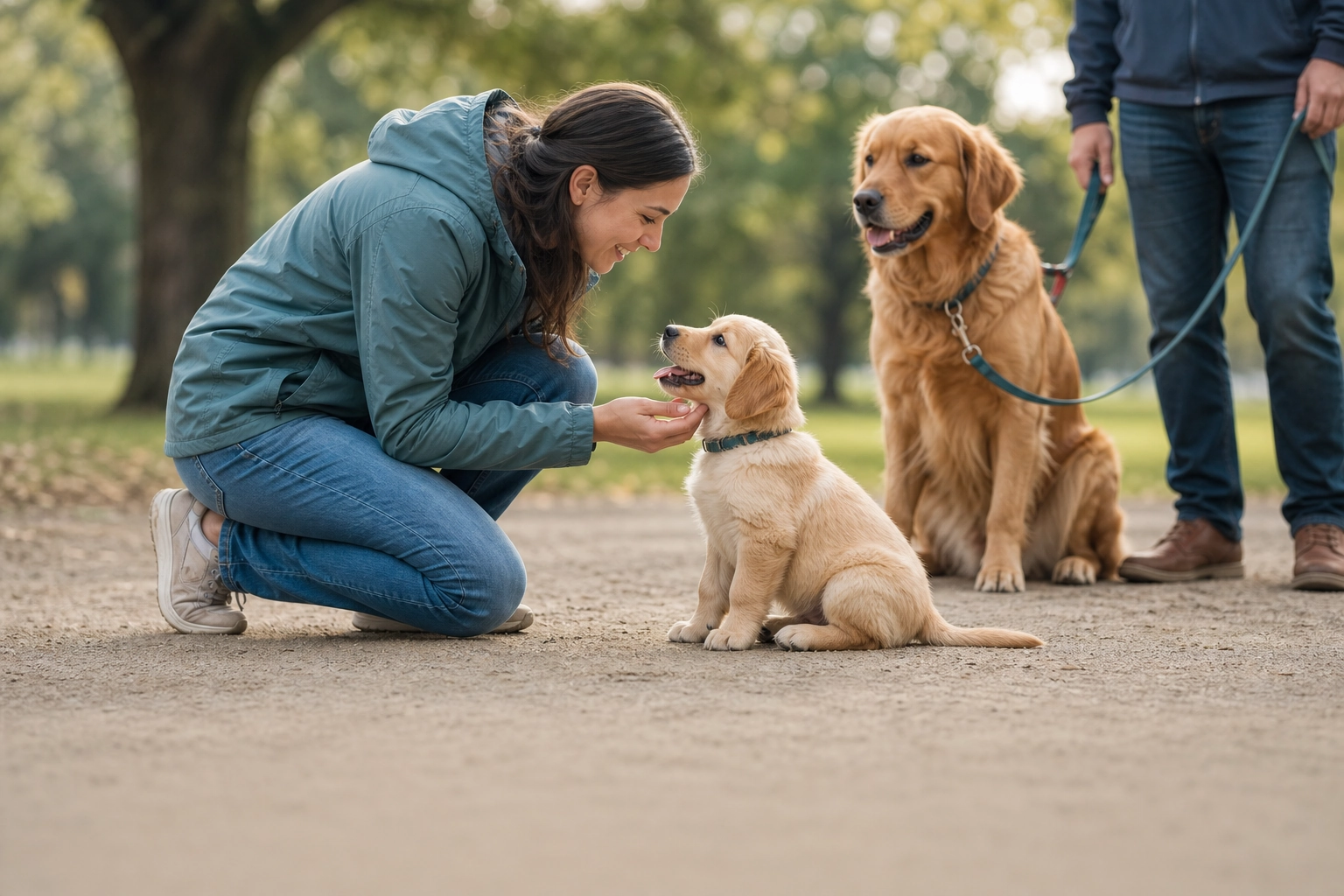
Many people think of taking a puppy out to meet the world as just a bit of fun. But as a vet, I can tell you that proper dog socialization can genuinely "save your dog's life." It is the key that turns a tiny puppy into a confident, well-behaved, and happy adult dog.
The single greatest window of learning in a dog's life opens at around 3 weeks of age and closes between 16 and 20 weeks. During this period, a puppy can take in all sorts of sights, sounds, smells, and textures fully and without developing lasting fear.
Although the most sensitive phase ends at around 4–5 months, experts recommend that you keep socializing your dog continuously until at least a full year of age to build lasting confidence.
Once your puppy moves in with you, the job of carrying this process forward becomes yours. Here are the simple principles.
The world is still new and strange to a puppy. Think of everything they encounter as a chance to build a good memory. Try to list as wide a variety of objects, people, and surfaces as possible.
Having different people in the household help with training pulls your puppy out of their comfort zone and teaches them they can face new things no matter who they are with. You can turn it into a fun game for the kids by having them record the new things the puppy met each day, such as "met a person in a baseball cap" or "heard a siren."
Avoid piling on too many stimuli too fast. If you want your puppy to get used to being picked up or handled by strangers, start with household members first, then gradually add one or two strangers at a time.
Once your puppy can handle small stimuli, it is time to expand their world.
Remember that a dog over 5 months of age is already an adolescent and should no longer be allowed to play-bite.
A question I hear often is, "I want to socialize my 3-year-old dog — what should I do?" because owners want their dogs to have fun playing with others. But animal behavior science tells us that fully grown dogs can live perfectly happy lives without ever setting foot in a dog park or playing off-leash.
As dogs reach social maturity (between 1 and 3 years of age), most of them no longer enjoy playing with large groups of strange dogs. They often choose to walk away, hover close to their owner, or even bare their teeth and give a warning snap to a pesky adolescent dog running up to them. This behavior is not abnormal — it is natural and common in grown dogs. For rescued dogs still adjusting, take a look at our rescue dog training tips.
If you still want your grown dog to have a playmate, schedule meetings one-on-one (one dog at a time) and follow these steps.
Socializing a dog is not about forcing them to love every living thing on earth. It is about helping them feel "secure and safe" in an environment full of new things. The more we understand the nature of each stage of their life, the stronger and happier the bond between you and your dog becomes.
1. Why does dog socialization matter, and when is the "critical window" you must not miss?
Socialization is not just a leisure activity; in veterinary terms it can genuinely save a dog's life, because behavior problems are the number one cause of death in young dogs. The "golden window" when a puppy absorbs new experiences best and without lasting fear falls between about 3 and 16-20 weeks of age. Use this period to introduce them to a variety of sights, sounds, people, and textures in the right way, and keep training continuously until a full year of age to build long-term confidence.
2. How should owners set up home exercises to reduce food-bowl guarding and prevent separation anxiety?
You can build good behavioral foundations through simple daily home exercises. To reduce food-bowl guarding, walk up while your dog is eating, drop an even tastier treat into the bowl, and walk away, so your dog learns that a person approaching at mealtime means good things. To prevent separation anxiety, set aside time each day for your dog to be alone in a safe space with no people or other pets around, alongside gentle handling practice and getting used to everyday sounds.
3. If a fully grown dog (1-3 years old) does not like playing with other dogs at the park, is that abnormal?
Not at all. In animal behavior science, once dogs reach social maturity they become choosier about their friends and often no longer enjoy playing with large groups of strange dogs at the dog park, which is natural behavior for a grown dog. If you want your dog to have a playmate, arrange one-on-one playdates: choose a polite dog, walk together at a safe distance using a leash to keep things safe, and allow brief sniffing only once the body language is relaxed.
4. When a dog enters adolescence and starts to become fearful or play-bites, what should the owner do?
A dog over 5 months is an adolescent and should no longer be allowed to play-bite. If they bite too hard during play, let out a loud "Ow!" and stop playing immediately; never squeeze the muzzle, shout, or pin them down, as this only increases fear. As for fear itself, never punish a dog for showing fear because it only reinforces it. Instead, remove them from the situation right away and ask for a different behavior, such as a "sit."


