


 Thailand (THB)
 United States (USD)
 Singapore (SGD)
 African Country (USD)
 Australia (AUD)
 Canada (USD)
 Egypt (USD)
 European Country (EUR)
 Hong Kong (HKD)
 India (USD)
 Iran (USD)
 Iraq (USD)
 Japan (JPY)
 Myanmar (USD)
 Oman (USD)
 Qatar (USD)
 Saudi Arabia (USD)
 Switzerland (CHF)
 Taiwan (USD)
 Turkey (USD)
 UAE (USD)
 United Kingdom (GBP)
 International (USD)
 Written by
Why do dogs fear thunder? Storm phobia is very common and has a real genetic basis. Understand the causes from a scientific angle, plus 5 tips to help your dog through a stormy night gently.
During a storm or heavy rain, one of the most distressing things for dog owners is their dog's panic at thunder and lightning — what veterinarians call Storm Phobia. This is no small matter, because in severe cases it's enormous stress that erodes a dog's quality of life. Today I'll walk you through this condition from a scientific angle, along with 5 ways to help your dog through a stormy night as gently as possible.
Noise sensitivity is the most common anxiety-related trait in dogs. A survey of over 13,700 Finnish pet dogs found noise sensitivity in as many as 32%, increasing with age — especially fear of thunder (Salonen et al., Scientific Reports, 2020). This aligns with a risk-factor study in which 43.6% of owners reported their dog showed fear of thunder (Gähwiler et al., Applied Animal Behaviour Science, 2023). So if your dog fears storms, you are far from alone.
Many assume fear is purely a matter of personality, but in fact genes really are involved. A genome-wide association study (GWAS) in 330 German Shepherds found a locus significantly associated with noise sensitivity on chromosome 20 — a region containing genes involved in glutamatergic and dopaminergic neurotransmission and the hearing system, which also overlaps loci linked to human neuropsychiatric disorders (Sarviaho et al., Translational Psychiatry, 2019). That research group also estimated the heritability of fearfulness at around 0.36–0.49, which helps explain why some dogs are naturally more sound-sensitive and anxious than others. This connects with genes and dog behavior.
Beyond genes, age, breed, and environment matter too. Fear of thunder tends to become more pronounced with age (before declining in very old dogs as hearing fades). Dogs living in detached houses tend to be more fearful than those in apartments, and importantly, dogs become significantly more fearful if their owner shows fear, because they pick up on our anxiety (Gähwiler et al., Applied Animal Behaviour Science, 2023).
The goal of care is to shift your dog's emotion from "fear" to "safety," and to reduce the perception of triggers — both sound and light — during the storm. Here are 5 practical approaches.
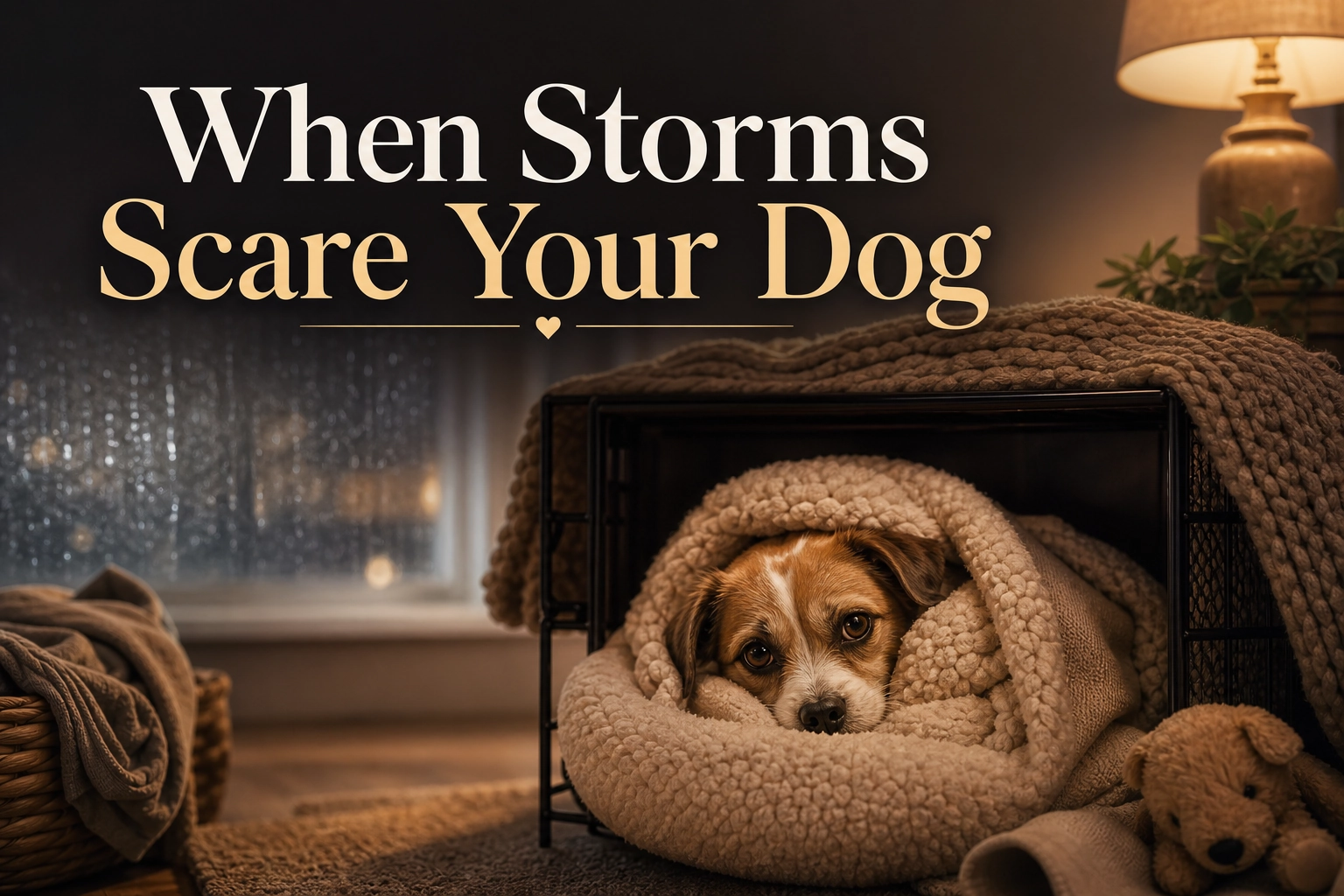
Prepare a "Safe Spot" in advance when the forecast shows a 40% or higher chance of storms. It should be an enclosed room in the center of the house, a bathroom, or a windowless corner to block lightning flashes. If there are windows, use blackout curtains. If your dog likes a crate, drape a thick blanket over it to muffle sound, and play masking sound such as white noise, a fan, the TV, or soft instrumental music to reduce the perception of thunder.
When your dog trembles or paces in panic, what you must never do is scold, punish, or yank them, because it makes them learn "storm = punishment" and fear worsens next time. In daily life, train a "cue–response–reward" pattern (e.g., ask for a sit, then give a treat) to build trust, so your dog learns to look to you for guidance when feeling insecure.
Use counterconditioning to turn fear into a positive feeling: every time thunder sounds, immediately offer a small, high-value treat so your dog associates thunder with good things. If your dog won't eat or can't move, the fear is above their learning threshold — switch to hugging, gentle stroking, or play instead. Also train a "Settle" (lie calmly in their own spot) outside storm times, so it can replace anxious pacing during a real storm.
In the safe spot, include a soft bed, a favorite toy, or long-lasting chews — because chewing and licking help release calming chemicals in the brain, turning a scary time into a more pleasant one.
For dogs whose fear reaches panic — destroying the house or self-injury — medication under veterinary guidance is a necessary and highly effective option. Details are in the next section.
If you've adjusted the environment and behavior and your dog still panics badly, seeing a veterinarian to prepare medication for the rainy season is the right choice. These are mostly fast-acting drugs given about 1–2 hours before the storm — for example drug that reduce the fight-or-flight response, drug that reduces anxiety, and blunt memory of the frightening event, and drug that reduces arousal. All must be prescribed and dosed by a veterinarian only.
Storm phobia is a condition that needs understanding and systematic management. The most important thing is for owners to stay calm and not panic with the storm, so you can be your dog's emotional anchor. Gradually adjust the environment following these 5 points, and if your dog still panics badly, consulting a veterinarian to prepare medication can greatly improve quality of life for both of you. If you'd like to understand your dog's genetic and behavioral basics more deeply, feel free to consult the Geneus Pet team.
1. How common is storm phobia?
Very common. A survey of over 13,700 Finnish pet dogs found noise sensitivity in 32%, and some studies report up to 43.6% of owners say their dog fears thunder.
2. Is fear of thunder genetic?
Yes, partly. A GWAS found a locus associated with noise sensitivity on chromosome 20, but environment and training also matter a great deal.
3. Should I scold or comfort my dog when it fears thunder?
Never scold or punish — it makes the dog associate storms with punishment and worsens the fear. Instead, create a sense of safety and use rewards.


