


 Thailand (THB)
 United States (USD)
 Singapore (SGD)
 African Country (USD)
 Australia (AUD)
 Canada (USD)
 Egypt (USD)
 European Country (EUR)
 Hong Kong (HKD)
 India (USD)
 Iran (USD)
 Iraq (USD)
 Japan (JPY)
 Myanmar (USD)
 Oman (USD)
 Qatar (USD)
 Saudi Arabia (USD)
 Switzerland (CHF)
 Taiwan (USD)
 Turkey (USD)
 UAE (USD)
 United Kingdom (GBP)
 International (USD)
 Written by
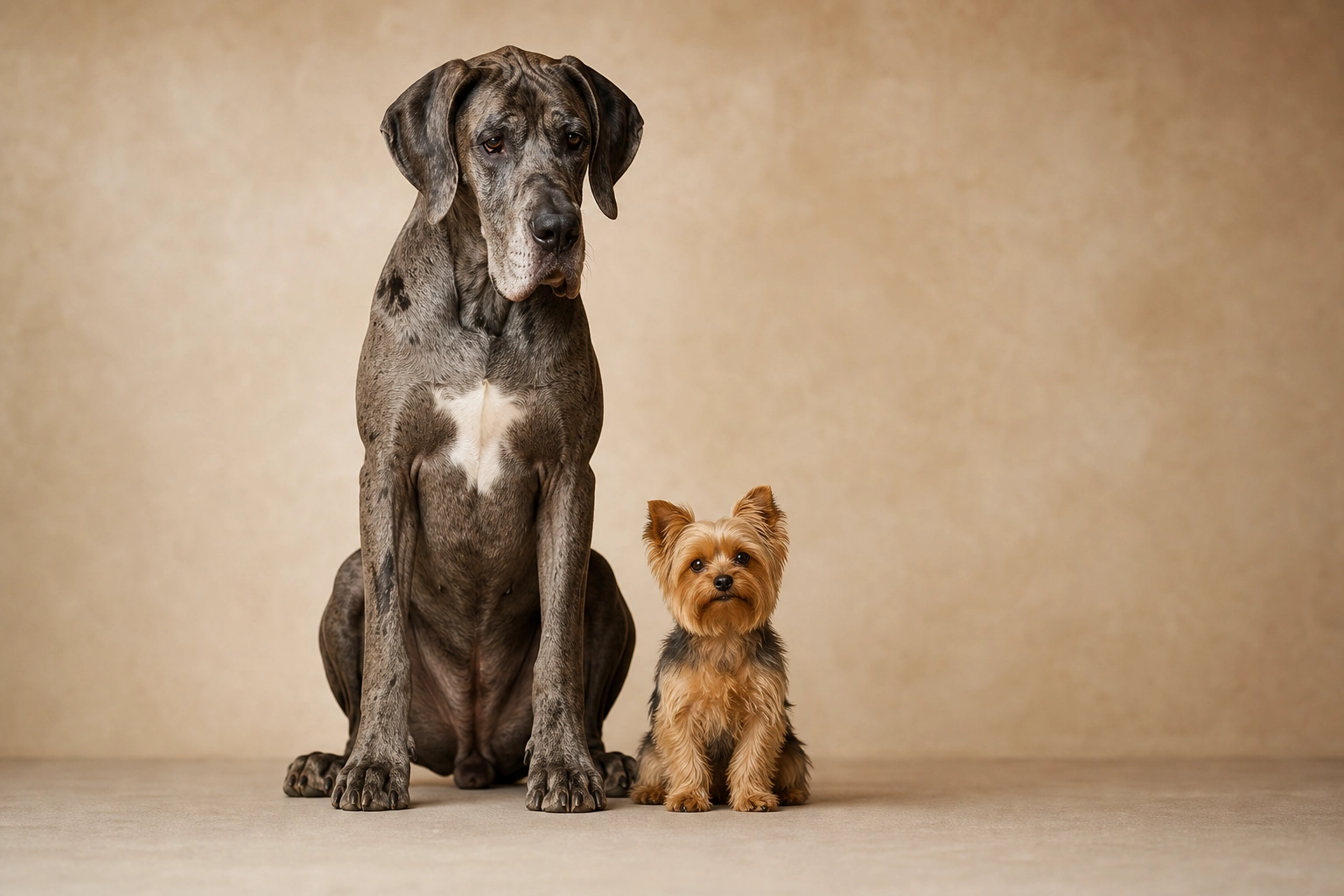
A dog's size isn't just about shape — it's tied to lifespan, cancer risk, and temperament. I break down the differences between large and small breeds that you may never have known.
Whenever a pet parent comes to me for advice on choosing a dog, I often hear the question, "Isn't the only difference between small and large dogs just their size?" My answer is: not at all. A dog's size is deeply tied to its lifespan, disease risk, and even its temperament. Today I'll walk you through the differences hidden behind body size, so you can understand and care for your companion more precisely.
In the dog world there is a striking rule: "the bigger the dog, the faster it ages" — which runs counter to most mammals, where larger animals tend to live longer.
Research by Cornelia Kraus, an evolutionary biologist at the University of Göttingen in Germany, analyzed data on more than 56,000 dogs across 74 breeds and found that large breeds undergo an "accelerated" aging process. Put simply, big dogs live life in fast-forward. If you'd like to understand your dog's true age in human years, read more in Calculating a Dog's Age with DNA.
Because of their rapid growth, large breeds clearly carry certain health risks that are higher than in small breeds.
Some of these differences are set at the genetic level. If you're curious how genes determine your dog's size, read on in Genetics and Your Dog's Size.
Many people are familiar with the image of a small dog that barks a lot, spooks easily, or rarely listens to commands — creating the stereotype that small breeds are "worse behaved" than large ones. A research team at the University of Veterinary Medicine in Vienna surveyed more than 1,276 dog owners and found three interesting differences:
The key question is: do these traits come purely from genetics? The research points to "owner behavior" playing a major role, through three main factors.
Small-dog owners tend to be less strict than large-dog owners because they see small dogs as easy to control, so they often give in and neglect setting rules — leaving the dog without a sense of accountability for basic commands.
Doing activities together — whether obedience training, playing fetch, or going for walks — directly affects a dog's obedience. A small dog that is carried around all the time misses out on this.
Harsh leash-yanking, loud scolding, or physical punishment actually makes the dog more anxious and aggressive.
Behavior is also rooted in the genetics of emotion and temperament. Read more about this in Genes, Behavior, and a Dog's Temperament.
Differences in body size also shape a dog's energy, vocalization, and social behavior.
Whether your dog is small or large, exercise suited to their size matters a lot. See the guidance in A Physical Exercise Guide for Dogs.
Small breeds are more prone to barking or growling because of their anxiety and fearfulness, using sound as a preemptive defense. Studies of small breeds such as Chihuahuas, Toy Poodles, and Miniature Schnauzers found similar behavior patterns under stress — namely intensive barking — often motivated by "fear" arising from feeling vulnerable given their small size relative to the outside world.
Small breeds tend to react more negatively to strangers, for instance barking or trying to nip to defend their space, whereas large breeds are usually more tolerant and assess situations more calmly. Many large breeds are known as "gentle nannies" that tolerate rough play from children well, while small breeds may become anxious or injured easily from rough play. Using the standardized C-BARQ tool, breeds such as Chihuahuas and Poodles were found to have higher-than-normal levels of "direct social fear" — and it is this fear that turns into aggressive behavior when a stranger approaches.
1. Why do large breeds have shorter lifespans and age faster than small breeds?
Research shows that large breeds undergo an accelerated aging process because their bodies must work harder to maintain a large frame, and their rapid growth from puppyhood also raises the risk of abnormal cell division that can turn into cancer. Small breeds, by contrast, grow gradually, so their cells and bodies deteriorate more slowly, giving them longer average lifespans.
2. Is barking, jumpiness, and stubbornness in small breeds caused by genetics or upbringing?
Both factors play a role. Genetically, small dogs feel vulnerable because of their size, making them more prone to anxiety, fearfulness, and barking for self-defense. However, owner behavior matters greatly too — inconsistent training, lack of shared activities, and harsh punishment all contribute. Switching to positive reinforcement and taking your dog out for activities helps reduce these behaviors.
3. How does activity and training differ between large and small breeds?
Large breeds need high-energy activity to stay emotionally stable and obedient, and owners tend to prioritize their training because they are hard to control when disobedient. Small breeds tire easily and short walks are enough, but they still need consistent training and clear rules to improve obedience and reduce aggression toward strangers.


